Power Imbalance in Indonesian Partnerships: Building Equity Beyond Titles and Hierarchy
Another central challenge in partnership brokering is power imbalance—a dynamic that becomes even more pronounced in Indonesia’s culturally hierarchical environment. Building equity is important, and this principle is crucial in contexts where authority and seniority tend to dominate discussion and decision-making.
Indonesia’s social fabric is steeped in respect for hierarchy. In most settings—corporate, government, or community—seniority determines who speaks, who decides, and who feels entitled to question decisions. Junior staff often feel it is inappropriate to disagree with a senior leader. Even when they have valuable insights, expressing objection risks being seen as impolite or disloyal.
This dynamic can create internal power imbalances within local teams. But when international partners join the equation, the layers multiply. Donor organisations, foreign consultants, and international organisations often enter with perceived superior expertise or resources. Indonesian partners may defer excessively, feeling their perspectives carry less weight.
Women experience an additional layer of imbalance. Social norms may subtly discourage women from taking the floor in certain settings, and their ideas may not receive the same level of respect. Despite being technically collaborative, these inequalities can result in partnerships where a few powerful voices practically dominate.
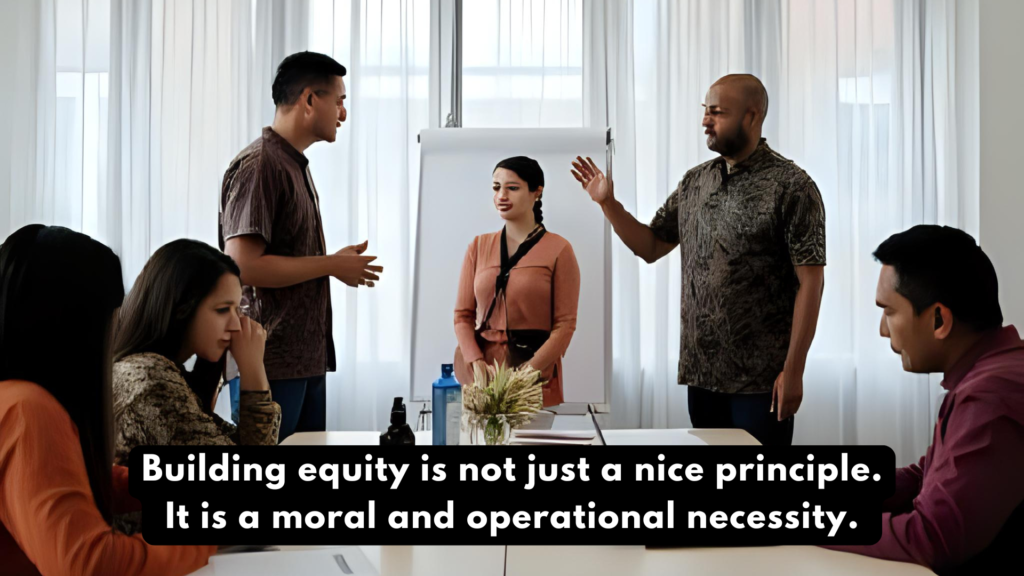
Building equity, then, is not just a nice principle—it is a moral and operational necessity.
Partnership brokers can play a critical role in redistributing voice, authority, and influence so that all partners can meaningfully contribute.
In Indonesia, building equity means:
- Creating intentional facilitation structures where juniors can speak without contradicting seniors directly.
- Acknowledging the power that foreign partners carry, and proactively moderating it so local voices lead.
- Designing meetings where women’s contributions are specifically welcomed and amplified.
- Ensuring decisions are not made solely by those with resources or status.
- Using pre-meetings or breakout groups to allow quieter members to process and contribute.
Equity also requires recognizing that power imbalances are not always visible. Hidden hierarchies—between organisations, ethnic groups, or professional backgrounds—shape how people show up. A partner may appear passive not because they lack ideas, but because they feel their perspective is not valued.
Partnership brokers must read these dynamics and intervene with nuance. This might involve reframing who “gets to” lead discussions, inviting local wisdom as equal to technical expertise, or slowing down the decision-making process to allow marginalized voices to emerge.
Global minority-world partners need particular guidance here. They may be accustomed to egalitarian team structures, unaware that Indonesian colleagues may not feel equally empowered to speak. Without cultural awareness, foreigners can unintentionally reinforce power imbalances—dominating discussions, setting agendas, or placing expectations that silence equals agreement.
Building equity requires patience, intentionality, and cultural literacy. It requires understanding that partnerships thrive when every partner feels their voice matters—not just symbolically, but practically. When equity becomes a guiding practice, Indonesian partnerships transform. Decisions become more inclusive. Implementation becomes more grounded in local realities. And most importantly, all partners share risks and benefits more fairly, as intended in the true spirit of partnership.
The article was also published in LinkedIn: https://www.linkedin.com/pulse/power-imbalance-indonesian-partnerships-building-equity-desy-mutialim-9wwic