
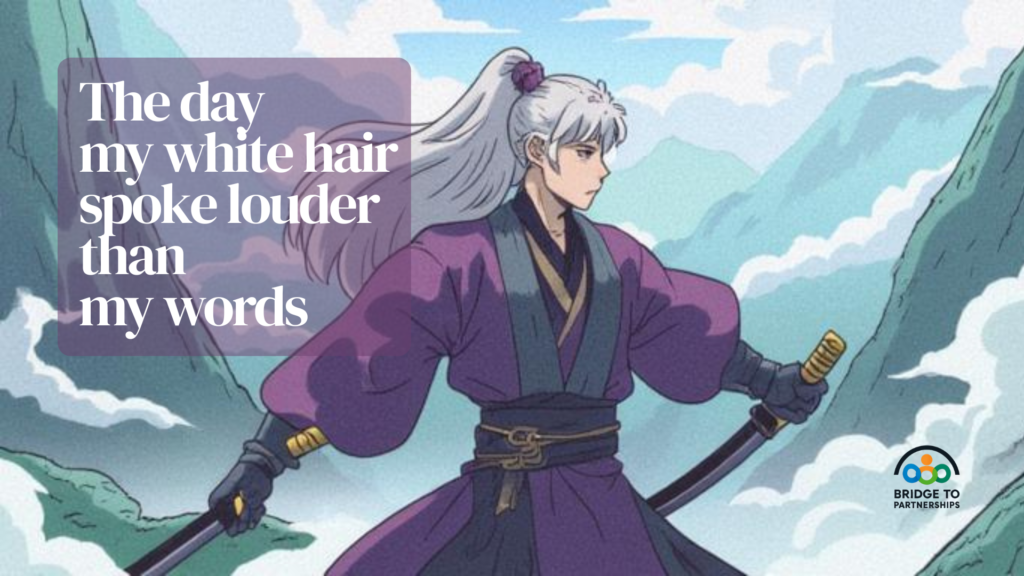
I always wonder why the heroes in Chinese martial arts movies generally have white or grey hair. I found this on Google as I tried to figure it out: in Chinese wuxia (martial arts) and xianxia (fantasy) movies, white or silver hair on heroes is a strong visual trope that instantly conveys great power, deep sadness, extreme dedication, or supernatural status. This style doesn’t show regular old age. Instead, it makes characters stand out as special, often putting them apart from normal people. Hmm, that’s interesting!
My hair has turned white, but the funny thing is that it is only at the front, like horse bangs. My hairdresser always says it’s cool and different. I also enjoy looking at it, so I often dye that part in different colours like purple, red, and green. I do this for fun and to elevate my mood.
One day, I forgot to dye it. I only realised this when I was getting ready to lead a discussion in one place. I saw the white hair sticking out at the front of my head when I looked in the mirror. I wasn’t really confident, but, ‘Ah, never mind. I’m not young anyway,’ I told myself encouragingly.
Many people in the room were astonished when I walked in. A lot of them have met me before. A few of them came right up to me and said, ‘Ibu, how old are you really?’ I grinned and answered their question. They were surprised and responded, ‘Wow, sorry. We always imagined that you were considerably younger.’ What a compliment!
I know that in Indonesia, it’s not unusual for people to react this way. However, I found it interesting that after they found out my real age, their attitudes and actions toward me changed a lot. I notice that participants paid more attention when I talked and were more careful about how they spoke to me. I think this change is amazing.
I immediately remembered that in Indonesia, seniority, including age, is important. Or perhaps this phenomenon happens in many Asian cultures as well. Having white or silver hair, in certain contexts, is associated with increased trust and respect. Apparently, white hair traditionally symbolizes wisdom, honour, and knowledge or experience. White hair is often interpreted to represent dignity and the accumulation of life lessons.
In simple terms: those who are the same age as me assume that I am now at the same level as them. Younger people think they must listen to me, assuming I have more experience.
However, I learned that this phenomenon perhaps doesn’t happen in countries with different cultures. I once read a LinkedIn post that conveyed research results showing that women with gray or white hair are perceived as less competent.’ In Western societies, having gray or white hair is associated with older women, and this is considered an undesirable characteristic because they are seen as incompetent or unpleasant. I don’t know if the claim is true.
I also realised that my white hair is a form of nonverbal communication that conveys certain messages to many people, which in the end can gain trust from them. This is an advantage for me because as a facilitator, it is important to gain the trust of all participants so that the discussion runs smoothly and meets the objectives.
I used to think that white hair needed to be fixed. I now know that it just needs to show up. In some rooms, it signals decline. In others, it signals depth. But the actual change happened inside of me. So I think I’ll be like one of those Wuxia heroes. I stopped dying my white hair because I now trust what it says without my consent. Some signs are louder than words. This one, it turns out, was on my side all along.
@partnershipbrokersassociation
The same content is also published on Instagram (@bridgetopartnerships) and LinkedIn:
https://www.linkedin.com/pulse/day-my-white-hair-spoke-louder-than-words-desy-mutialim-zomcc





No Comments